
Home Macquarie Flex
Hybrid cloud for Government that saves 25% on Azure.
Macquarie Flex hybrid cloud management services give Government agencies flexibility and control across Azure workloads, using familiar tools while moving workloads between Azure public cloud and sovereign environments. Reduce operational risk with Australia’s leading Microsoft partner, and save an average of 25% on Azure infrastructure.
Macquarie Flex
Full centralised control.
Government agencies often operate complex hybrid environments. Multiple platforms, strict compliance expectations and limited internal resources can make it difficult to manage cloud workloads efficiently. Macquarie Flex simplifies hybrid operations by putting Azure at the centre, enabling agencies to run workloads across public and sovereign environments through one consistent interface. With Macquarie Flex, agencies can:
- Run workloads across Azure public cloud and sovereign infrastructure depending on performance, compliance or cost requirements.
- Manage hybrid environments through the familiar Azure portal using existing tools and skills.
- Access 24×7 monitoring and support from Australian engineers experienced in Government environments.
- Apply consistent governance, security updates and policy management across hybrid platforms.

Value you see
Right workload. Right environment.
Macquarie Flex is a purpose-built hybrid cloud management service designed for the Australian market. It helps government agencies transform hybrid environments with unified control, consistent governance and measurable cost savings.
Same Azure UX
Use the same Azure portal, APIs and tools across public cloud and sovereign environments so teams work consistently across platforms.
Flexible architecture
Move workloads between Azure public cloud and Azure Local environments when requirements change, without operational disruption.
Proven savings of 25%
Reduce Azure infrastructure costs with a hybrid model that removes wasted spend and aligns workloads with the right platform.
Sovereign and compliant
Run sensitive workloads in Australian sovereign data centres with consistent governance, Azure policies and monitored compliance.
Workload placement
Get clear guidance on where workloads should run to balance performance, compliance and cost across hybrid infrastructure.
Ready for modern workloads
Support data-heavy applications and future AI initiatives with a consistent Azure foundation across hybrid environments.
Use cases
Hybrid cloud that supports Government priorities.
See how Government organisations use Macquarie Flex to manage costs, support compliance and simplify hybrid operations.
Public cloud optimisation
Public cloud costs can grow quickly across large Government environments. Macquarie Flex helps agencies move the right workloads into Azure-native infrastructure where spend is easier to control and optimise.
Modernising virtualised environments
Licensing and platform changes across traditional virtualisation platforms are prompting many Government teams to reassess long-standing environments. Macquarie Flex provides an Azure-consistent alternative with sovereign infrastructure options.
Preparing for licensing renewals
Hybrid visibility helps agencies understand which workloads belong in public cloud and which should move elsewhere before entering long-term licensing agreements.
Reducing operational burden
Government technology teams often operate with limited resources. Macquarie Flex simplifies hybrid operations with a single Azure management experience and expert support handling day-to-day platform operations.
Real savings
Savings that scale as you do.
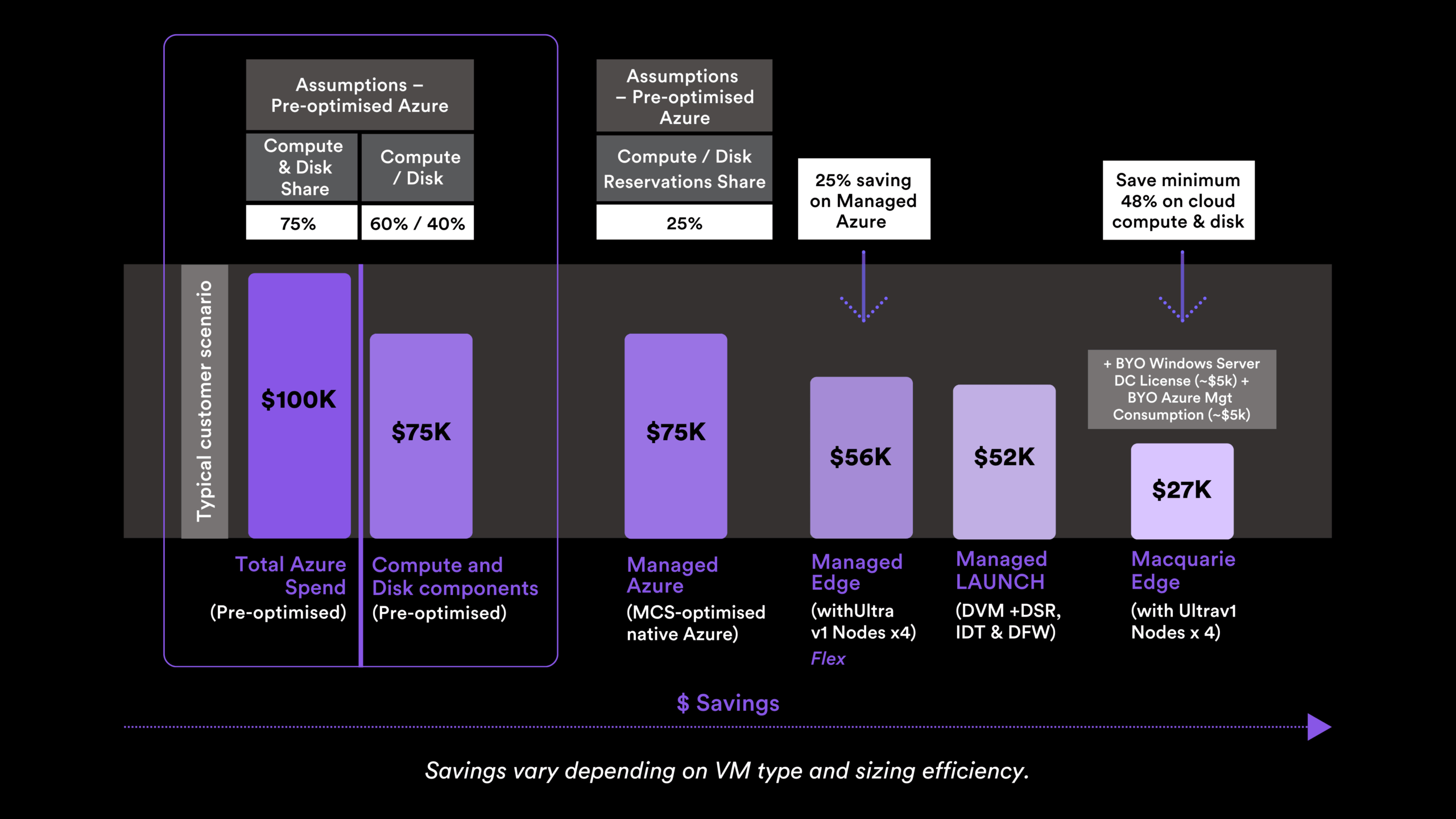
Macquarie Flex customers see an average saving of 25% on Managed Azure infrastructure. As workloads are placed on the most appropriate platform, efficiencies can grow further as hybrid environments are optimised over time.
Built for government. For your agency.
Why Macquarie Government
A hybrid cloud partner, trusted by Government.
Microsoft-aligned, sovereign by design and experienced in supporting highly regulated environments.
Australia’s #1 Microsoft partner
One of only five Australian providers with Azure Expert MSP accreditation and MISA membership.
Leading Azure Local capability
First in Australia to deliver Azure Local using Dell APEX Cloud Platform as a Premier Solution.
Operational maturity from day one
Hybrid environments are delivered with monitoring, policy enforcement and management already in place.
Sovereign infrastructure
Workloads run in Australian data centres we own, with data residency and governance controls built in.
Australian engineers, 24×7
Support from locally based experts who understand Government operational environments.
Trusted service experience
Our live NPS of +87 is industry leading, because our team always takes responsibility for the outcomes.
Explore your options
Take the next step in your hybrid cloud strategy.
Whether you’re assessing cloud costs or planning hybrid architecture, we can help you make the next informed decision.

Our no-cost Azure assessment highlights where spend is going, where governance needs strengthening, and which workloads should run in Azure native, Azure Local, or sovereign platforms.

Meet with a cloud specialist to review your environment, requirements and constraints. You’ll receive clear guidance on the most effective hybrid approach for your agency.
Want a clearer view of your hybrid cloud options?
Related solutions
Extend your hybrid cloud strategy.
Our related services support hybrid infrastructure across security, data and Azure operations.

Sovereign hosting for workloads requiring predictable performance, strict governance or controlled infrastructure environments.

Fully managed Azure operations aligned to governance and compliance expectations within Government environments.

Strengthen security posture across hybrid environments with monitoring, governance and incident response capabilities.

Secure and manage Microsoft Fabric foundations for trusted analytics, reporting and AI-ready data environments.
Not sure where to start? We’ll help you build a cloud that fits how your agency operates.
Contact us
Talk to an expert.
Access guidance on the most effective hybrid cloud model for your environment.
- 1800 004 943
- Level 15, 2 Market Street Sydney, NSW, Australia
Hybrid Cloud FAQs.
What are hybrid cloud management services, and what do they cover?
Hybrid cloud management services provide day-to-day operations across Azure and private or sovereign infrastructure. This typically includes monitoring, patching, backup, incident response, policy enforcement and ongoing optimisation. The goal is a consistent operating model across environments, rather than separate tools and processes for each platform.
How should Government agencies evaluate a hybrid cloud provider?
Start with a shortlist and assess providers based on operational coverage (24×7 support, SLAs and escalation), Azure capability, experience managing sovereign infrastructure and the maturity of their governance and security practices. It’s also useful to request a proof-of-concept that demonstrates monitoring, policy enforcement and cost controls across both environments.
What should a strong hybrid cloud strategy include?
A practical hybrid cloud strategy defines workload placement rules, governance standards, security controls and operational processes such as change management, patching and incident response. It should also include a cost model that balances predictable infrastructure with variable Azure consumption, along with an approach that avoids long-term platform lock-in.
How can a partner help manage the variable cost of Azure consumption?
Managing Azure spend requires disciplined cost governance. This includes tagging standards, budgets and alerts, rightsizing workloads and regular reporting. A strong partner will also help agencies place workloads on the most appropriate platform, whether Azure public cloud, Azure Local or sovereign infrastructure, to reduce unnecessary “always-on” costs.
What questions should agencies ask a managed cloud services provider about cost control?
Agencies should ask how the provider reports and reviews cloud spend, how they identify and remove waste, and how policies such as tagging, budgets and guardrails are enforced. It’s also important to understand how the provider models cost scenarios and determines the most appropriate platform for each workload within a hybrid architecture.
Can one provider manage both Azure and sovereign environments?
Yes, if the provider operates an integrated hybrid service model. This means the same monitoring, patching, governance and security practices apply across both environments. Consistent tooling and operational processes ensure agencies are not effectively managing two separate platforms under a single contract.
How is hybrid cloud security managed across different environments?
Security should be applied consistently across platforms through shared identity, policy and monitoring frameworks. This typically includes automated policy enforcement, continuous monitoring and defined responsibilities for incident response and remediation across the entire hybrid environment.
What does hybrid cloud architecture mean in practice?
Hybrid cloud architecture refers to the design approach that allows workloads to run across Azure public cloud, Azure Local and sovereign infrastructure while maintaining consistent identity, governance and management. A well-designed architecture reduces complexity by standardising how services are deployed and operated across environments.
When does it make sense to move workloads from public cloud to sovereign infrastructure?
In some cases, workloads may be better suited to sovereign environments. This can occur when public cloud costs increase faster than the value being delivered, or where data residency, governance or operational requirements are easier to meet within sovereign infrastructure.
How can agencies validate savings claims when comparing hybrid cloud providers?
Ask providers to explain how savings are calculated, including the baseline used and what factors are included in the comparison. A proof-of-concept or assessment can help demonstrate potential savings across representative workloads and show how optimisation will be maintained over time.